
Hard House Coffee
Editorial publication · research-based guidance
Editorial note: Hard House Coffee separates researched guidance from hands-on testing. Product links may be affiliate links at no additional cost to you. See our research and recommendation methodology and disclosure.
The price threshold is only shorthand
There is no technical border at exactly $1,000. Prices vary by market, tax, bundles, and time. The useful distinction is between compact entry-level machines and larger designs that spend more on temperature control, steam capacity, construction, and serviceable components.
A higher price can make the workflow easier to repeat, but it cannot replace a capable grinder, fresh coffee, suitable water, or good puck preparation.
What the major features change
Dual boilers
PID control
Pre-infusion and flow
Steam capacity
Buyer profiles
| Buyer | Useful upgrade | Lower-priority feature | Question to ask |
|---|---|---|---|
| Straight-espresso hobbyist | Temperature control and repeatable flow | Maximum steam power | Is the grinder already good enough? |
| Milk-drink household | Dual boilers and steam recovery | Flow profiling | How many drinks are made in sequence? |
| Frequent entertainer | Water capacity, recovery, durable controls | Small footprint | Can the circuit and counter support it? |
| One quick morning drink | Fast warm-up and simple cleaning | Large boiler mass | Will a compact machine be more practical? |
Group design and warm-up
Larger metal groups can provide thermal mass and stability, but they may need more time and energy to reach an even operating temperature. Compact saturated or actively heated designs can warm differently. Manufacturer “ready” indicators may refer to brew water, not every cup-contact surface.
Match the warm-up behavior to your routine. A machine that is technically impressive but rarely fully warmed can be less useful than a simpler machine that fits the morning.
Serviceability and ownership
- Confirm whether parts, diagrams, and authorized service are available in your region.
- Check electrical requirements, dimensions, water-tank access, and whether direct plumbing is optional or required.
- Use water that balances flavor with scale protection; follow the manufacturer rather than a generic descaling schedule.
- Budget for group gaskets, shower screens, filters, cleaning detergent, and eventual pump or valve service.
- A rotary pump can support quieter operation and plumbing on some machines; a vibration pump can be simpler and less expensive.
When the upgrade is worth it
Upgrade when the current machine prevents you from making drinks in sequence, makes temperature changes too difficult, lacks the steam capacity you need, or cannot be serviced economically. Those are concrete workflow limits.
Do not upgrade because expensive equipment is assumed to make every shot better. If the grinder is inconsistent, the water is unsuitable, or the coffee is stale, spending the same money on those fundamentals can produce a larger practical improvement.
Examples, not a universal ranking
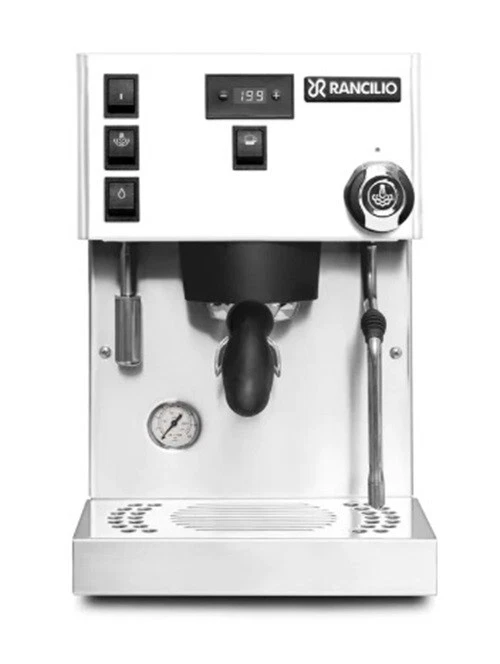
Machines such as the Rancilio Silvia Pro X, compact dual-boiler models from Profitec, and larger ECM machines illustrate different combinations of boiler design, size, pumps, controls, and finish. Exact model specifications and prices change. Hard House Coffee compares documented design and buyer scenarios here; it does not claim personal testing or declare one model best for every buyer.