
Hard House Coffee
Editorial publication · research-based guidance
Editorial note: Hard House Coffee separates researched guidance from hands-on testing. Product links may be affiliate links at no additional cost to you. See our research and recommendation methodology and disclosure.
The machine price is not the setup price
“Around $300” can describe a machine tier, but it rarely describes the complete cost of making controllable espresso. You still need a grinder suited to espresso, a small scale, coffee, water, cleaning supplies, and possibly a better-fitting tamper or basket. Retail prices and bundles change, so treat the number as a shopping category rather than a guaranteed current price.
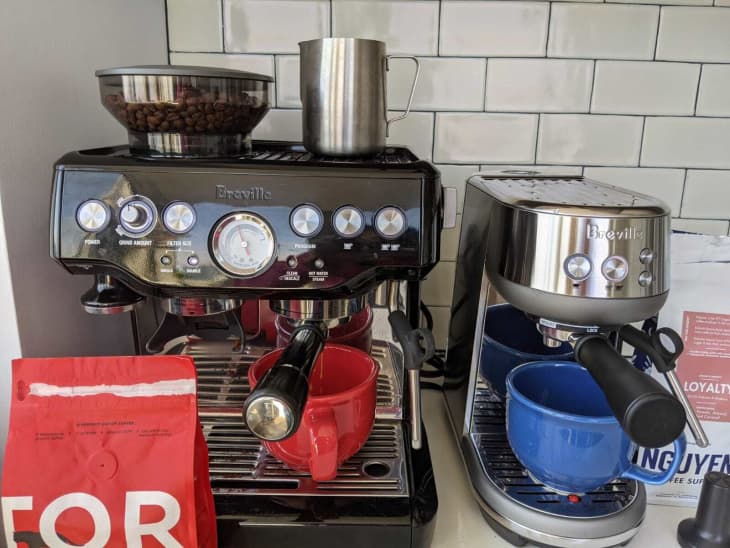
A compact machine such as the Breville Bambino can make sense in this category because it focuses on a quick thermoblock workflow and a small footprint. The buyer still has to provide the grinder and technique.
Build the real budget
| Part | Why it matters | Where to be careful |
|---|---|---|
| Machine | Controls water delivery and steam workflow | Confirm included basket, warranty, and current price |
| Espresso grinder | Makes small grind changes possible | Do not assume every burr grinder can dial in espresso |
| Scale | Shows dose and beverage yield | Choose one that fits the drip tray |
| Tamper and distribution | Helps prepare an even puck | Fit matters more than decorative accessories |
| Water and cleaning | Protects flavor and equipment | Follow manufacturer guidance for hardness and descaling |
| Coffee | Freshness and roast change dialing-in | Buy smaller bags while learning |
What a compact budget machine does well
Fast preparation
Small footprint
Learning the essentials
The compromises
Budget machines often have lighter construction, smaller water tanks, less room under the group, simpler temperature control, and limited capacity for several drinks in a row. Steam performance may be slower than a larger boiler machine. Those limits may not matter for one morning cappuccino; they matter more for entertaining.
- Shot consistency still depends heavily on the grinder and puck preparation.
- Back-to-back milk drinks can expose recovery and steam limitations.
- Included pressurized baskets may be forgiving, while unpressurized baskets reveal grinder quality more clearly.
- Repair economics can differ from serviceable prosumer machines; check parts and warranty before buying.
A realistic starting recipe
Use the basket’s recommended dose range and begin near a 1:2 ratio. Weigh the dry dose and stop the shot when the beverage reaches roughly twice that mass. Taste before changing anything. If the shot is fast and sharp, grind finer. If it is slow and dry, grind coarser. Avoid prescribing a fixed tamp pressure; a level, fully compressed puck is more repeatable than trying to reproduce a bathroom-scale number.
Alternatives and upgrade paths
Buy used carefully
Save for the grinder
Choose another brew method
Who this tier suits
Choose a compact budget machine when you make one or two drinks, accept a hands-on learning period, and can fund the grinder and maintenance. Save for a higher tier when you need several milk drinks in sequence, want more temperature control, or value long-term serviceability. This assessment is research-based and does not claim that Hard House Coffee personally tested or owns the machine.